
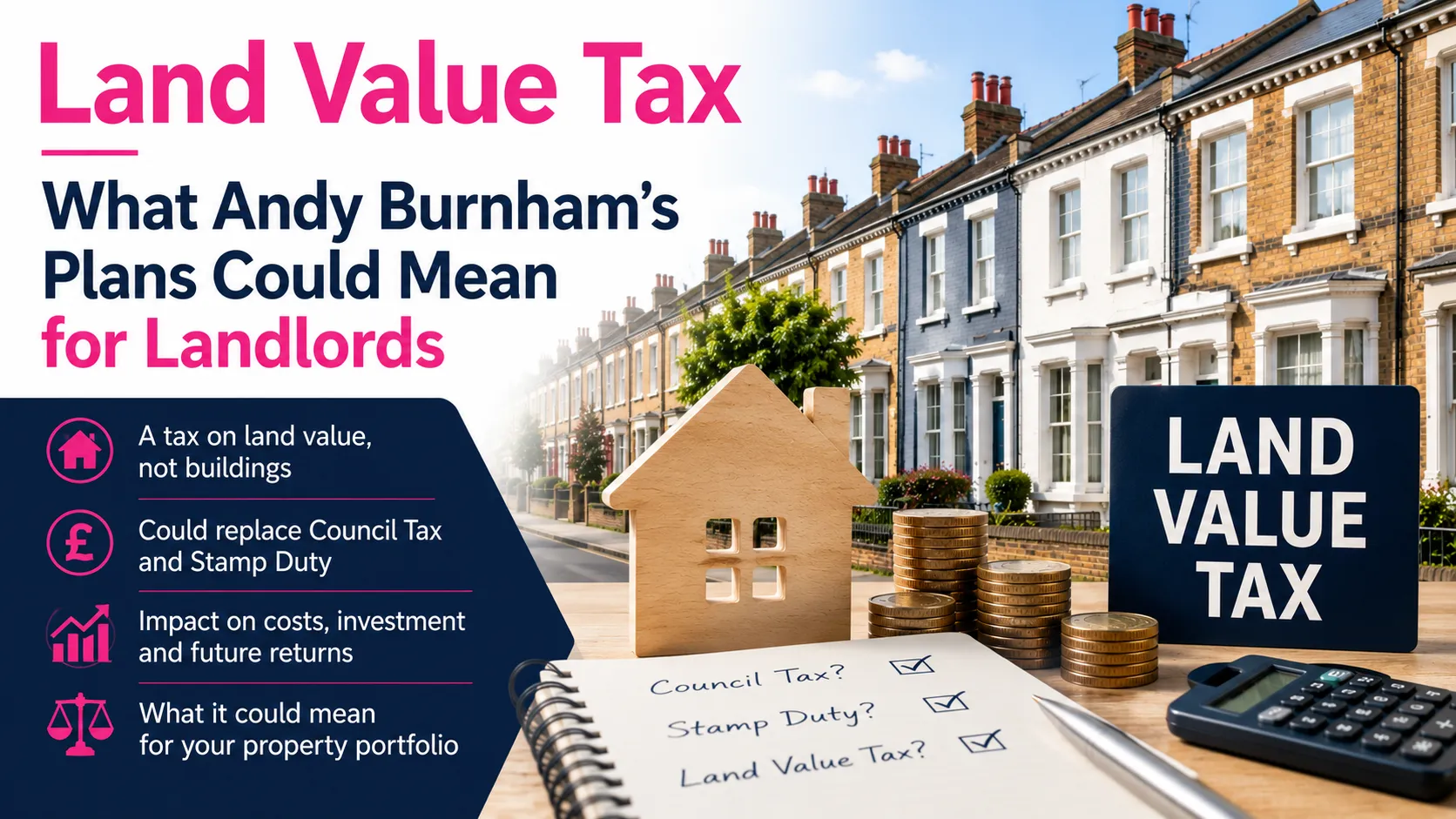
Property taxation in the UK may be about to change more than it has in thirty years. The idea attracting most attention right now is a Land Value Tax - a recurring charge based on the value of the land a property sits on, rather than the building itself.
It's back in the headlines because of Andy Burnham. Following Keir Starmer's resignation as Prime Minister on 22 June 2026, Burnham has emerged as the clear frontrunner to succeed him, and he's been open for years about wanting to scrap Council Tax and Stamp Duty in favour of something land-based. At his campaign launch in Makerfield in May, he said he'd "long been persuaded of the argument for a Land Value Tax" and called Council Tax "highly regressive." None of that makes him Prime Minister yet, and none of it amounts to a finished policy - but it's a good deal more than idle speculation.
For landlords, the temptation is to read a headline like "new property tax" and assume a bill is coming. It isn't, not imminently. What exists at the moment is a direction of travel, a handful of campaign comments, and some serious independent modelling - not legislation. The sensible response is to understand how the system might work, who stands to gain or lose, and how it could reshape investment decisions, rather than to panic about numbers nobody has actually confirmed.
What is a Land Value Tax?
A Land Value Tax is charged annually against the value of a plot of land, in principle excluding whatever's built on it - extensions, refurbishments, a new kitchen, all of it sits outside the assessment.
The thinking behind this is that a huge amount of a site's value comes from things the owner never did. A new tram stop, a regenerated high street, a good secondary school half a mile away - these push land values up regardless of what the owner has or hasn't done to the building. So under a pure LVT, two similar plots next to each other could face similar bills even if one has a beautifully renovated home on it and the other has a wreck. The logic is that you're taxing location, not effort.
This is also why economists tend to like land taxes more than most others. The OECD has argued that recurring property taxes are generally less harmful to growth than many alternatives, and that taxing land specifically is preferable to taxing buildings or improvements on it.
Why is the UK's property tax system under pressure?
Start with Council Tax. It's still based on 1991 valuations - over three decades old - so a home's banding often bears little relation to what it's actually worth today. The Institute for Fiscal Studies has long described the wider system of property taxation as messy and inconsistent, and has examined how Council Tax, Stamp Duty, business rates and landlord taxation might be reformed together.
Stamp Duty is a different kind of problem. It's not an annual charge - it lands all at once, when you buy, and can add tens of thousands of pounds to a purchase. Critics argue this discourages moves that would otherwise make sense: a family delaying an upsize, an older couple putting off downsizing, someone turning down a job because relocating is too expensive. Landlords have to factor it into every acquisition too, and it eats directly into returns.
International research broadly backs shifting tax burden away from the moment of purchase and towards a recurring annual charge instead, on the basis that yearly taxes create fewer barriers to moving house than a large one-off hit.
Worth knowing: one piece of reform is already locked in, separate from any of this LVT debate. A "mansion tax" - officially the High Value Council Tax Surcharge - was introduced in the November 2025 Budget and applies to homes worth over £2m from April 2028, on top of existing Council Tax. It's not a land value tax and it doesn't replace anything, but it shows the direction the tax system is already moving in.
How might a Burnham-backed Land Value Tax actually work?
There's no finished proposal to point to. What's been reported is that Burnham's team has been looking at ideas from Fairer Share, the cross-party campaign group, which would replace Council Tax and Stamp Duty with a single annual charge.
It's worth being precise here, because two different things keep getting run together in the coverage.
Fairer Share's own proposal is a Proportional Property Tax, not strictly a land value tax - it charges a flat 0.48% of a property's whole value (building included), rising to 0.96% on second homes, empty homes and overseas-owned property. It claims 75–77% of households would pay less.
A genuine Land Value Tax taxes only the land underneath. Independent modelling from Tax Policy Associates, published this July, put the revenue-neutral flat rate at around 1.28% of land value to replace both Council Tax and residential Stamp Duty - though their own sensitivity testing shows that figure could plausibly land anywhere between 1.1% and 1.7%, mostly depending on an assumption nobody can currently verify: what proportion of a typical property's value is land rather than bricks and mortar.
Burnham has spoken favourably about both ideas at different points, which is part of why the detail matters so much. A tax on land only behaves quite differently from a tax on the whole property - particularly for anyone thinking about renovating.
Three questions remain genuinely open: whether the new tax would replace Council Tax and Stamp Duty together or just one of them; who's legally on the hook (LVT is normally framed as a charge on the landowner, which for rental property means the landlord, not the tenant); and what rate would actually apply.
Would landlords pay more?
It depends entirely on the property. A landlord holding high-value land in London or the South East, where land makes up a large share of total property value, is likely to feel it. A landlord in a lower-value area could end up paying less overall, especially once the removal of Stamp Duty is factored in.
Tax Policy Associates' central model - which includes transitional relief and a deferral option for people who can't pay upfront - found around 68% of households would be better off in immediate cash terms under a full land-and-council-tax-replacing LVT, and about 32% worse off. Without those softening measures, more people benefit on paper but the losses for the remaining group are sharper. Either way, these are illustrative modelling outputs, not a forecast of the policy that eventually gets legislated.
Geography matters more than almost anything else here. The same modelling shows the biggest winners clustered in deprived areas of the North East and coastal towns - Hartlepool, Blackpool, Middlesbrough - where land values are low relative to Council Tax bills. The biggest losers are concentrated in prime London and the commuter belt, where land is worth a fortune. A one-bedroom flat in Kensington & Chelsea could see its annual bill rise by roughly £4,000 under this model; a typical home in Blackpool could see Council Tax replaced by next to nothing.
Your investment strategy matters too. A landlord who buys and sells frequently stands to gain more from scrapping Stamp Duty than one who holds a mature portfolio for decades. A long-term holder effectively trades a one-off acquisition tax for a permanent annual cost - useful for cash needed at completion, less useful for twenty years of cash flow.
Could landlords simply pass the tax on to tenants?
Probably not, at least not directly. Rents aren't set by adding up a landlord's costs; they're set by what tenants can afford and how much competing supply exists locally. In a tight rental market a landlord might recover some of a higher tax bill over time. In a weaker market, trying to push rents up risks longer voids and a less competitive listing.
The more interesting effect happens before rent ever changes: economists call it capitalisation. Buyers factor future tax liabilities into what they're willing to pay for a property today, so land facing a heavier LVT bill could simply become cheaper to buy. Tax Policy Associates' own analysis treats this as one of the biggest unresolved questions in the whole debate - their modelling suggests the overall national effect on prices is small, because the new tax mostly replaces existing Council Tax and Stamp Duty rather than adding to it, but underneath that calm average there could be sharp falls in high-value areas like Kensington offset by real gains in places like Blackpool. For landlords carrying significant debt, a fall in capital value could affect loan-to-value ratios and refinancing options, regardless of what happens to rental income.
Could scrapping Stamp Duty actually help investors?
This is probably the clearest upside for landlords. Stamp Duty is a large upfront cash cost, worse still with the additional-property surcharge, and it can't usually be funded through the mortgage. Removing it would lower the barrier to restructuring a portfolio - selling properties that no longer fit the strategy and reinvesting where tenant demand is stronger, without the transaction cost getting in the way each time.
But it's worth resisting the assumption that no Stamp Duty automatically means better off. An investor with no acquisition tax but a permanent Land Value Tax liability running for twenty years could, over that period, pay more than they would have under the current system. The number that actually matters is total lifetime cost, not what's owed on completion day.
What about property improvements?
A genuine Land Value Tax shouldn't rise because you fit a new kitchen, insulate the loft or convert the garage - the land underneath is valued on its location and permitted use, and the value you've added through investment sits outside the assessment. That's a meaningful difference from Fairer Share's Proportional Property Tax, which taxes the whole property and would, by definition, capture the value of improvements too. Tax Policy Associates estimate a 0.48% annual PPT is roughly equivalent to a 16% upfront tax on the value created by a home improvement - which is exactly the kind of disincentive a pure LVT is designed to avoid.
The line isn't always tidy in practice, though. Planning permission alone can dramatically increase what a plot is worth, so a valuer would still need to think about a site's development potential, not just its current use.
Could it discourage land banking and empty homes?
That's the theory. A vacant or underused plot would still attract a bill based on its land value - you couldn't dodge the charge by leaving a site empty or letting a building decay. That could push more land into productive use, which for landlords and developers might mean more sites coming to market.
It could equally squeeze smaller owners sitting on land with development potential but no immediate finance or planning certainty to build. A site valued on what it could become, not just what it currently is, might generate a large annual bill years before it earns anything.
Why this would be hard to actually implement
The principle is simple. The administration isn't. Splitting land value from building value across millions of residential properties is genuinely difficult - plausible in dense cities where similar plots trade often, much harder in rural areas or on unusual sites where there's little market data to work from.
Denmark is the cautionary tale often cited here: it introduced a land tax in the 1920s, suspended new valuations in 2013 after finding three-quarters of assessments bore no relation to market prices, and is still rolling out an automated replacement system nearly a decade past its original deadline. The UK's own attempt at land value taxation, under Lloyd George between 1909 and 1914, was repealed in 1920 without ever really working. None of that means a modern attempt would fail the same way - valuation technology has moved on considerably - but it's a reasonable dose of caution about how long this would take to get right. A former Bank of England deputy governor has suggested three to five years of preparation would be needed before implementation, which, if anything, may be optimistic given the history.
What about people with valuable homes but modest incomes?
This is the classic objection: an older homeowner sitting in a house that's appreciated hugely, on a pension that hasn't. The same issue could affect landlords whose properties have gained value on paper while producing a fairly ordinary rental yield.
Tax Policy Associates' model includes a deferral mechanism - letting eligible owners roll up part of the increase, with interest, until the property is sold - plus a ten-year phase-in to soften the transition. These are modelling features, not confirmed policy, but they show the kind of transitional tools that would almost certainly be needed. Every protection added this way also reduces the revenue raised and adds complexity, which is part of why nobody has landed on a final design yet.
What should landlords actually do right now?
Nothing drastic. There's no confirmed rate, no start date, and - with Burnham still only the frontrunner rather than the incumbent Prime Minister - no certainty this even becomes government policy in its current form.
That said, it's a reasonable moment to stress-test a portfolio against higher annual ownership costs rather than assume the current system is permanent. Understand the balance between land value, rental yield and borrowing in each property. A high-value, low-yield asset in an expensive area is more exposed to a shift towards annual land taxation than a more modest, higher-yielding property elsewhere - the geography in the modelling above makes that fairly clear.
Anyone weighing up a new purchase should look past the current Stamp Duty saving and think about total cash flow over the likely holding period, not just the cost on completion day. And it's worth keeping good records now - purchase prices, improvement spend, planning history, valuations, rental performance - since all of it will matter if and when a reform like this starts to take shape.
The outlook for landlords
A Land Value Tax has supporters across a surprisingly wide political spectrum, because it promises to fix several real problems at once: it could reduce the barriers to moving house, discourage sitting on undeveloped land, and stop penalising people for improving their own property. The OECD's broader case for shifting tax away from transactions and towards land backs that up.
The costs are real too. Some owners, particularly in high-value areas, could face substantially larger annual bills. Building a valuation system capable of separating land from buildings at scale is a serious undertaking, and transitional protection would be essential for people who genuinely can't absorb a sudden increase from their current income.
For now, this remains a live political debate rather than a compliance requirement. Landlords should keep making decisions based on the law as it stands, while keeping half an eye on what happens to Burnham's leadership bid and any detail that follows from it.


Share this with
Email
Facebook
Messenger
X
Pinterest
LinkedIn
Copy this link